Ask any Wisconsin lake homeowner about their favorite time of year, and they’ll tell you it’s the exact moment the ice goes out. Ask them about their least favorite day, and the answer comes just as fast: "Dock Weekend."
For decades, putting the dock in for the season has been a dreaded rite of spring. It traditionally required rounding up an army of reluctant relatives, donning freezing-cold waders, throwing out your back lifting heavy steel pipes, and wrestling with rusted set screws. By the time the dock was level, everyone was exhausted, muddy, and sore. We sat down with the shoreline engineering team to discuss how patented folding leg mechanics eliminate this spring headache entirely.
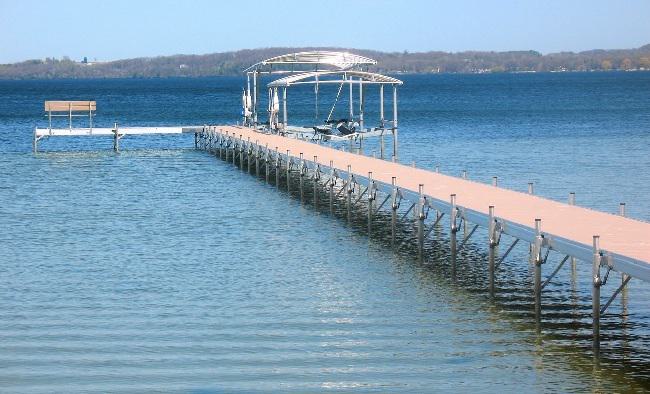
Why Has Spring Dock Installation Traditionally Required an Army?
The traditional approach to pier installation relies on brute force rather than mechanical advantage. Property owners are forced to enter frigid water to manually support weight while securing heavy frame sections—a process fraught with physical strain and setup hurdles:
- Heavy Structural Materials: Pipe and wooden sections absorb water, increasing total weight and requiring multi-person lifts.
- Complex Submerged Hardware: Standard leg brackets rely on set screws that rust, slip, or seize up underwater.
- Wader-Dependent Mechanics: Traditional leveling mechanisms force you into waist-deep water before the deck surface can even be placed.
How Does Patented "Tip-In" Engineering Keep You Dry on Shore?
The engineering team at Pier of d'Nort re-imagined the installation sequence to perform all heavy lifting from dry land or the safety of an already installed section.
1.Position the Lightweight Frame:Perform completely from dry land.
Carry the aluminum frame down to the shore or to the edge of your previously installed dock section without needing winches, ropes, or extra assistance.
2.Engage Dual-Hinged Leg Deployment:Self-deploying mechanical action.
Tip the section forward. Thanks to the integrated dual-hinged leg design, the dock legs fold outward automatically into position as the frame tilts.
3.Tip and Lock into Place:Automatic latch engagement.
Allow the section to tip down and splash into the water. The flip-in latch mechanism automatically locks the section firmly into the dock track without requiring hand tools.
Comparing Installation Requirements
| Feature | Traditional Pipe / Wood Dock | Pier of d'Nort "Tip-In" System |
| Crew Required | 3–5 People | 1 Person |
| Water Entry | Required (Waders / Wet Suit) | None (100% Dry Land Installation) |
| Hardware Tools | Wrenches, Sockets, Clamps | Tool-Free Latch System |
| Leg Mechanics | Manual Submerged Placement | Automatic Dual-Hinged Folding Legs |
| Average Setup Time | Half-day to Full Day | Under 1 Hour |
How Does Easy Installation Extend Your Boating Season?
By eliminating the physical barrier to the water, you change your relationship with the changing seasons. You no longer need to wait for a sunny, 75-degree weekend in late May to bribe helpers. On the first crisp Saturday of spring, a single person can tip sections into place in minutes and park the boat immediately—effectively adding weeks to your summer.
Want to know how this same design makes winding down the summer just as effortless? Stay tuned for Part 2: The Smooth Autumn Transition.