Selecting the right dock system requires analyzing how the structure interacts with your lake's unique environment. While floating docks are often marketed as a universal solution for deep water, they introduce significant trade-offs in stability, ease of installation, and boat safety when compared to a stationary, sectional aluminum dock. For shorelines with manageable depth variations, a sectional "Tip-In" dock provides distinct engineering advantages.
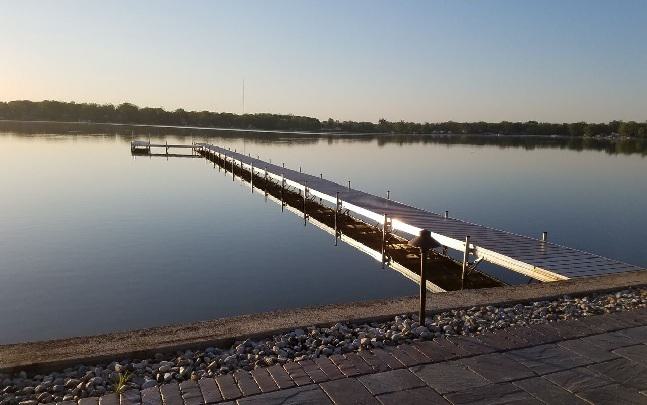
Stability and Walking Experience
The fundamental difference between a sectional dock and a floating dock is how they handle gravity and weight distribution:
- Floating Docks: A floating dock relies completely on buoyancy. Because it rests entirely on top of the water, it moves dynamically with every wave, wake, and step. Walking on a floating dock can feel unstable or unbalancing, particularly for children, elderly guests, or anyone carrying gear. Furthermore, when stepping onto the edge of a floating dock to board a boat, the dock tilts under your weight, which can make boarding awkward or hazardous.
- Sectional "Tip-In" Docks: A Pier of d'Nort sectional dock is a stationary system supported by rigid aluminum legs resting firmly on the lake bottom. Large, welded footpads distribute weight evenly across sand, rocks, or deep muck. This creates an incredibly stable, unyielding platform that behaves exactly like a traditional deck on dry land. It offers total stability underfoot, regardless of heavy boat wakes or high foot traffic.
Wave Action and Boat Protection
How a dock responds to rough water is critical to protecting your watercraft investment:
Why Stationary Frames Protect Your Vessel Better:
- Firm Resistance Against Wakes: A stationary sectional dock stands firm above the waves. The water passes underneath the frame, leaving the walking surface completely steady.
- Eliminated Tugging Forces: Because a floating dock rides the waves up and down, a heavy boat tied to it creates continuous, violent tugging on cleats and mooring lines during rough weather.
- Superior Mooring Cushioning: When your boat is tied to a stationary dock equipped with our gripper-mounted vertical bumpers, the boat's movement is safely dampened against a completely immovable structure, preventing dock impact and reducing wear on your mooring hardware.
Comparing Sectional vs. Floating Dock Architecture
| Feature | Pier of d'Nort Sectional "Tip-In" | Floating Dock Systems |
| Walking Stability | Rock-Solid: Rigid legs rest directly on the lakebed | Unstable: Tilts, rolls, and sways with waves and foot traffic |
| Boat Mooring Safety | Immovable Frame: Dampens boat motion without tugging | Dynamic Motion: Moves with waves, causing heavy tension on cleats |
| Height Adjustments | Top-Side Cam: Quick wrench adjustments in seconds | Self-Adjusting: Moves with water, but restricted by mooring posts |
| Off-Season Storage | Compact Footprint: Frames fold completely flat to stack | Massive Footprint: Bulky floats & heavy anchor chains crowd shore |
Water Depth and Seasonality
Floating docks are highly effective in reservoirs with massive, sudden water level fluctuations (exceeding 4 to 5 feet) or in deep drop-offs where legs cannot reach the bottom. However, for the vast majority of natural lakes, water levels fluctuate more modestly throughout the summer.
A Pier of d'Nort system tackles changing water lines effortlessly with a built-in, one-way cam height adjustment system. Using a standard half-inch wrench from the dry top of the deck, you can loosen the cam to micro-adjust the height of any section in seconds—no diving under water or loosening rusted bolts required.
When it comes to seasonal removal, floating docks become highly unwieldy. They are bulky, heavy, require complex anchoring chains or heavy weights, and demand a massive footprint on your shoreline for winter storage. A Pier of d'Nort system uses modular, flat-folding sections. The legs fold completely flush against the lightweight frames, allowing an entire 40-foot pier system to stack neatly and compactly in a small corner of your yard or shed.
Quick Shoreline Checklist: Is a Sectional Dock Right for You?
Run through these simple shoreline checks to determine if a stationary sectional dock is the ideal choice for your property:
- The Depth Test: Measure your water depth at the furthest point of your intended pier layout. If your drop-off is under 15 feet deep, a sectional pier system offers far superior stability over a floating dock.
- The Foot Traffic Check: Consider who uses your dock. If young kids, elderly family members, or dogs frequent your shoreline, the firm deck-like surface of a sectional dock provides a much safer walking environment.
- The Off-Season Yard Space Evaluation: Look at your lawn storage area. If you want to keep your shoreline clutter-free in winter, flat-folding sectional frames stack in a fraction of the space required by bulky floating dock sections and anchor chains.
Unless you are dealing with extreme water depths or massive reservoir tidal changes, a stationary, sectional aluminum dock provides a safer, more stable, and significantly easier-to-manage solution for your waterfront.